
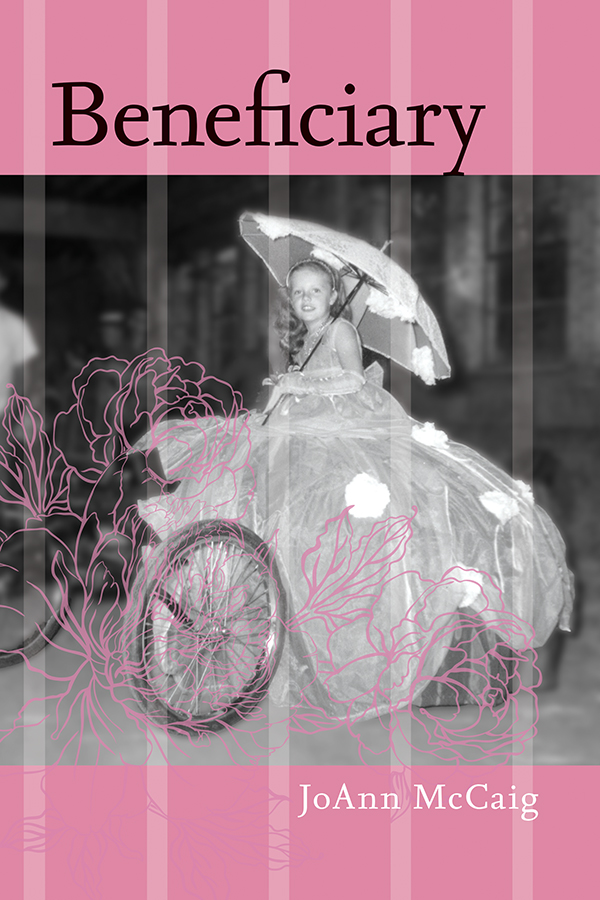
Beneficiary
The book explores the evolving feminism of the 1960s, 70s, 80s, and beyond, and the pressure on women to “have it all” and “be it all” particularly in the experience of main character Seren.
#1 Calgary Bestseller June 2026
“Vibrant, raw, funny and poignant,Beneficiary tells the uncensored story of Seren, a woman who chafes at the expectations her gender and privilege impose as she struggles through the challenges and joys of singledom and motherhood to live a life that is unabashedly genuine, unapologetically her own.”
— Joan Crate, author of Black Apple
JoAnn McCaig is a very bookish person, and is the author of Beneficiary, An Honest Woman, The Textbook of the Rose, and the critical study Reading In: Alice Munro’s Archives. She taught university English for many years and is now the owner of an independent bookstore in Calgary.
Welcome, reader…
EXCERPT
The hip joint of the domestic feline at six months of age is slightly smaller than a pea. How does Seren know this? Well, she knows it because she has one in her purse.
The call came one night a couple of weeks ago—the neighbour’s voice: “Your little cat is grey, isn’t it? Well, I’m afraid there’s been an accident.” Seren stopped to rummage in the linen closet for an old towel, one that she wouldn’t mind throwing away afterwards. The driver stood next to his car with Mort in his arms; he looked devastated, Mort merely irritable. The guy said, “We love cats, she just ran right under, please let us help with the vet bills.” Seren said “Oh heavens no, it’s our fault,” bundling the cat in the towel and walking back to the house muttering Damn you, Mort, why couldn’t you get run over properly by a Camaro full of teenagers waving beer bottles and blaring AC/DC, they would’ve backed up and thumped over you again, just for the hell of it—
9:30 on a school night and Seren dragged the kids out of bed for the drive to the Animal Emergency Clinic, Emmy crazed with pleasure at the drama of it all, but Justin fell back to sleep in the van so she locked him inside and left him there while she and Emmy carried the cat in. When they came out fifteen minutes later, the van door was open and her five-year-old son was barefoot on the sidewalk in his Pittsburgh Penguin pajamas, talking to two young hookers at a payphone. Like his father, Justin has enough testosterone for two or three guys. Once last year he’d stood transfixed by a TV image of Madonna gyrating in pink satin and diamonds, and after a few moments of contemplation, declared, “I yike her.”
SYNOPSIS
On an ordinary Tuesday evening, a teenaged girl named Seren finds herself saying “no” — for reasons she doesn’t yet understand –to her perfectly nice boyfriend, and that “no” eventually leads her to question the gender arrangements of her 1970s world. Soon afterward, a moment comes when Seren suddenly sees her mother as little more than her father’s creature, and she rebels, big time. Adventures ensue as she parties on Vancouver Island, meets a handsome Irishman in a student pub, comes to know the joys and sorrows of marriage, motherhood, and divorce and then eventually stumbles into the mixed blessing of sudden wealth. In latter half of the novel, Seren journeys from a luxury resort in the Alps to a refugee camp in Greece, from an airport hotel in Mexico to a drug rehab, and eventually, full circle back to the familiar safety of a cabin in the mountains that her father built when she was in her teens. Here, at last, Seren just might find herself at home in the world.
“Seren lives in a world that she does not really enjoy, seeing its shortcomings and its paradoxes and finding little in common with her financial peers, but at the same time she remains in it. Life is filled with paradoxes, and Seren must sort through them and come to peace. How she approaches this leads to a very satisfying conclusion.
The author guides the reader, through Seren’s life, to consider “economic and social organization” of the worlds of privilege and poverty, of sexual inequality, of human relationships, of aspirations and goals. All this she does through the filter of her character Seren, pulling us into her thoughts and stimulating us to examine our own views. Beneficiary is a book that draws us back to key passages to reflect on life and values, to ponder the revelations of a very well-told story.”
— Anne M. Smith-Nochasak, author of A Canoer of Shorelines and The Ice Widow
“A gritty contemporary upside-down King Lear that asks how to love and be loved as a person of privilege in a world where too many are suffering.”
— Roberta Rees, award-winning author of Eyes Like Pigeons
BOOK REVIEWS
FreeFall: Review of Joann McCaig’s “Beneficiary”
by Sasha Yurchenko
Seren lived many lives. She was born into a picture-perfect family with matching sweaters and yearly personalized Christmas cards. She never fit in. On the break of 1970s, she escaped her pearls-around-neck life and rebelled through her teenage years and early twenties. Some think her life started when she married TJ and became a mother, though it might have been the end of her. Seren certainly felt more alive than ever after sudden inheritance brought her back to the life she once ran away from.
It is a story of a woman who is afraid of being defined. A mother, a divorcee, a rich girl… Seren never wants to live within constraints of one word. She seeks her life and freedom, avoiding yet falling victim to uncomfortable stereotypes that keep her safe. Seren is not a loveable character at first sight, but she becomes an old friend whose flaws you accept and cherish her honest charisma. Seren, as a teenager, is a seeker of an unknown fantasy; she rarely understands her own desires or actions of others. We see a more mature version of her later in life, although still clueless about the way people around her think and bitter about some tragic parts of her life. By the end of her life, Seren becomes a conscientious citizen with a stable moral compass. She is reflective of her life and her actions. She knows she isn’t perfect and she owns her flaws. “What she thought to herself was I don’t deserve this. But I accept it with gratitude” (214). After living a life of denying her privilege, she finally accepts it and sets out to help less fortunate, to make a difference in a meaningful way.
Beneficiary is a book for readers who take their time getting to know true nature of characters. JoAnn McCaig masterfully recreated Canadian 1970s to early 2010s depicting each decade as a distinct era for Seren. This book is packed with vivid detail; it replicates Seren’s emotional turmoil with great care that combines turns the novel into a beautiful recollection which often reads like a memoir. McCaig is not afraid of brutally honest sentences and sincere reckoning moments. The way she tells the story reflects the narrative in Seren’s head, highlighting the memories she considers of great importance to her character, while briefing through some significant parts, the ones she is doing her best to forget.
“A few days later, she woke up from yet another sweaty hallucinatory daytime dream and she knew exactly what was wrong with her: I miss my own pain. An ill-favoured thing, but my own” (88).
The author manages to create a palpable presence of a woman who is perceived so differently by every person in her life that a reader cannot help but wonder who she really is. Sometimes it remains a mystery to Seren herself. She makes mistakes, lots of them, which makes her character so compelling that it’s impossible to think of her less. Like all of us, she navigates this life with blind effort, and she is sincere about every turn.
Beneficiary by JoAnn McCaig | The Seaboard Review of Books
"Some Thoughts" - a review by of Beneficiary by Lucy E. M. Black
Beneficiary by JoAnn McCaig revolves around the retelling of Seren’s life’s story, who grows up in a wealthy family and rebels against the privilege of her circumstances. As a young adult, Seren pursues the nomadic life of a party-girl and regular drug user. When her father dies, however, she is suddenly thrust back into the responsibilities of a sizable inheritance and must decide how to live life on her own terms while also being accountable for the money she has at her disposal. Rather than change her lifestyle, she struggles to find a way to make a difference, all while fighting preconceptions about the wealthy and encountering barriers established by class and gender. Seren’s story of a ‘poor little rich girl’ aches with its contemplative look at power, privilege, good intentions and careful choice making. The intersection of wealth, class and status in the novel is treated with both delicacy and discernment, while Seren’s independent spirit and her desire to live an unencumbered but meaningful life is flavoured by the impacts of first and second wave feminism. An interesting and thought-provoking read.
“Meet Seren, a woman of razor sharp intelligence and humour to match, as she confronts the world around her, whether that be the world of nature, of single-motherhood, of a refugee camp, or of her very privileged family. In this searing engagement with modern life no one is let off the hook, least of all Seren herself. Raw, at times downright squirmy in its unflinching gaze, at other times hilariously angry, often deeply and thoughtfully loving, Beneficiary is always, always compelling. You will miss Seren after you’ve turned the last page, and you will not forget her. In Beneficiary, McCaig is at the top of her game. The book is structurally brilliant, but it’s Seren who will captivate: witty, complex, flawed, shining in her uniqueness.”
— Barbara Joan Scott, author of The Taste of Hunger and The Quick
MEDIA
HIGHLIGHTS
July 13, 2026
MEDIA
May 13, 2026
MEDIA
The Lit Room, CKCU Radio
Interview with host Susan Johnson
> LISTEN
Friday, May 15, 2026
MEDIA
Book Q&A’s with Deborah Kalb
INTERVIEW
1. What inspired you to write Beneficiary, and how did you create your character Seren?
My inspiration for writing the novel is that this character and her life story just kept pestering me and refused to stay in the drawer.
I wrote the early drafts of the first two sections of the novel, The Vigo Reaction and Family Fugue, in the 1990s when I was a beleaguered single mom in grad school. (Which is a good thing, because now that I’m a grandmother, I barely remember what it was like to be the mother of a bunch of little kids, but those two sections fortunately captured it.) Over the ensuing years as I worked on the novel, the central character’s name changed many times. First it was Sarah, then it was Sally. It was even Ramona for a while. But then, during Covid, when I made the commitment to complete the novel, “Seren” floated up out of the ether, so fresh and unfamiliar that I thought I’d invented it. And I loved the resonant suggestion that her life’s journey is one that moves toward serenity. However, I later learned Seren is in fact a fairly common Welsh name, AND just last year (and this is weird) I also stumbled upon a very early version of the novel in which my central character was named, you guessed it, Seren! So I guess the name was just meant to be.
2. How was the book’s title chosen, and what does it signify for you?
The original title was The Venus Hum, which comes up in an early draft (since deleted) when Seren’s young son is diagnosed with a venous hum, but she immediately imagines the word as referring to the goddess of love and not a body part. And to me, this mixup was indicative of how Seren’s ambivalence and confusion about romance was like a barely detectable hum or murmur in her heart. However, in 2004, Calgary author Suzette Mayr published a novel called Venous Hum, and I realized that I needed to find a new title. Still, my early plan was to name each section after a misheard or misspelled medical condition, like Venus Hum for Venous Hum. Hence The Vigo Reaction, which is what Seren hears her doctor say in the delivery room when he’s actually saying vasovagal reaction. And also Family Fugue which suggests a fugue state as well as a game show. I settled on the current title very late in the game when I finally began to see how Seren is the beneficiary not only of her father’s estate but also of all of her life experiences: every up, every down, every crazy-making and impossible situation, they all push her toward becoming the woman she was always meant to be.
3. Did you know how the novel would end before you started writing it, or did you make many changes along the way?
I never know how a book is going to end when I start writing. I am a meanderer. I just kind of wander around in the material and see what happens. I’m also something of a magpie, gathering shiny beads and bits of string and bringing them all back to the nest to weave into some kind of cohesive whole. For me, writing is a process of discovery, not the working through of a pre-set plan or idea.
4. The author Barbara Joan Scott said of the book, “The book is structurally brilliant, but it’s Seren who will captivate: witty, complex, flawed, shining in her uniqueness.” What do you think of that assessment?
It’s gratifying to hear such a generous statement. Let me put it this way: I’ve loved fiction since I was a child. And though I adored the work of Charles Dickens, one thing that always bothered me was his utterly flat depictions of female characters: they were either impossibly saintly (Agnes, Little Nell) or implacably evil (Estella, Miss Havisham) I want to read about characters who are fully rounded and puzzling human beings. I would rather that Seren be seen as interesting than as likeable or “relatable”.
5. What are you working on now?
There’s no new fiction on the horizon at the moment. (Well maybe a story or two — which, come to think of it, is actually how all three of my novels started out….) But I’ve published a few essays in anthologies lately, one in a collection about infertility called Barren, and another about my mom in a collection about family secrets. So my current plan is to gather together these nonfiction pieces, and add some new ones about various topics that interest and/or obsess me these days — like the hideous decline in literacy (spelling errors in The Guardian! A punctuation error in The New Yorker! A misplaced modifier in a national newspaper!) and perhaps publish a collection of personal essays.
6. Anything else we should know?
I’m active in several areas of the book world. For twenty years, I taught English at the University of Calgary. I co-founded and still own Shelf Life Books, an independent bookstore in my hometown of Calgary, Alberta. I was the co-founder of the literary press Freehand Books, and am currently the owner of a Saskatchewan based literary publishing company called Thistledown Press.
Thanks so much for your interest in my work, Deborah. I appreciate it.
May 18, 2026
MEDIA
The Miramichi Review
Why I wrote this book
> READ
June 5, 2026
MEDIA
JoAnn McCaig | The Road to Writing and Bookselling
The Artsy Raven Podcast
with JF Garrard
add date
MEDIA
Interview with ______
Calgary Herald
add date
MEDIA
Interview with _____ on [Name of Show]
[Name of network]
> LISTEN
Seren’s story of a ‘poor little rich girl’ aches with its contemplative look at power, privilege, good intentions and careful choice making. The intersection of wealth, class and status in the novel is treated with both delicacy and discernment, while Seren’s independent spirit and her desire to live an unencumbered but meaningful life is flavoured by the impacts of first and second wave feminism. An interesting and thought-provoking read.
— Lucy E.M. Black, “Some Thoughts”
EVENTS
Tuesday, May 26
7 pm
book launch party
For Beneficiary
Shelf Life Books
1302 4 Street SW
Friday, May 8
INTERVIEW
The New Book Network
Date T.B.A.
INTERVIEW
HOWL, CIUT 89.5 FM