By JoAnn McCaig
Normal people probably won’t like this book. By that I mean people who’ve never kissed a book. But, me – I loved this book. I loved this book so much that I held it to my lips and kissed the back cover a moment after I read the last page.
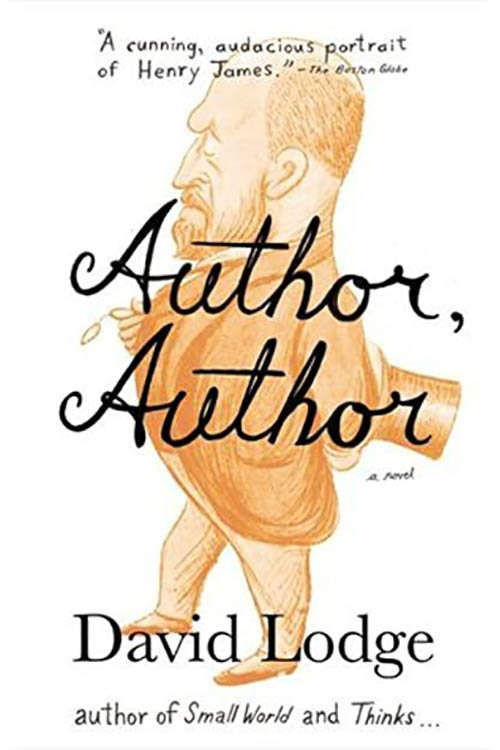
I already loved its author, David Lodge, best known for his comic novels of academic life, such as Nice Work and Changing Places. His characters are generally hapless romantics/academics with precarious reputations to protect and a variety of sexual insecurities. Author Author is a real departure for Lodge, because it is a historical novel based on factual details from the life of a real author, Henry James.
This novel is reader’s paradise of literary gossip…not the disguised, guessing game kind of AS Byatt’s Possession, but flat out….GB Shaw looked like this, HG Wells said that. Arnold Bennett was a nervous young critic with a stammer. The lovely daughter of James’ best friend became the lovely dying mother of the children who inspired JM Barrie to write Peter Pan, while a granddaughter became the author of the venerable thriller Rebecca.
On the question of his subject’s sexuality, Lodge wryly notes the way James has been “claimed” by queer theory but, for himself, Lodge takes the position that James was merely asexual – a position which feels reasonable to me under the circumstances.
One of the most fascinating pieces of literary gossip/history that emerges from the pages of Author Author is an account of James’ long friendship with George DuMaurier, a cartoonist for the magazine Punch. The warm friendship between the two men (and James had many friends) is at the heart and soul of this book about a writer’s life…because Lodge situates the bulk of the story in 1893-95 when Henry James made an unfortunate foray into writing for the theatre, while at the same time, his close friend DuMaurier tried his hand at the novel — and while James endured frustration, failure and even public humiliation, DuMaurier found himself with a bestseller on his hands, with a story called Trilby. All these years, I’d thought that the name Svengali came from some historical source, but no, the name used to describe a teacher/mentor who has a hypnotic power over his protegee comes from exactly such a fictional character in DuMaurier’s novel. Likewise the designation “trilby” hat. The name is that of the ingenue central character, but she wore no such hat in the book….the hat was added in Sir Max Beerbohm Tree’s stage version of the book. Such was the astonishing success of the novel that it became one of the first literary works to generate what kids these days call “merch”…hats, stoves, gloves. With great delicacy, Lodge sketches the bind in which DuMaurier’s sudden success places the two friends…here’s the much published and venerated, yet underpaid James trying to be generous, to quell his jealousy, to withstand the public humiliation of the dismal failure of his play Guy Domville…while DuMaurier, for his part, finds the consumer “boom” surrounding his work more of a curse than a blessing, and the general mania surrounding Trilby puzzling, even embarrassing.
What I loved most about this book though, was what it gave me about a writer’s life. It showed James in his moments of both triumph and despair…detailed how, faced with the cool reception of his collected works, the author descended into despair….but in the thrilling epilogue, Lodge gives the reader full value, doesn’t even need to point out that, more than one hundred years later, nobody…or few at least, certainly not me…remembers anything about a novel called Trilby…yet James’ underselling and often misunderstood work is now the stuff of literary societies, scholarly study, and graduate theses…as well as screenplay fodder for lovely films appreciative of James’ exquisite attunement to relationships, class, and the unsaid, and most particularly of his uncanny grasp of the chaos of a young woman’s heart.
The contemporary section of the novel ends with James repairing to his study, happy in the house of his dreams, which is set up for writing and socializing and beauty and an artists life – a house in which he “looked forward to the day’s work”.
I kissed this book because it reminded me that what matters is the work. That bestsellers come and bestsellers go. That fame and success can be a mixed blessing. That no-one can predict who or what will be read a hundred years from now. What matters is the work, the relationship between the artist and the work, the faith, the toil, the willingness to fail, the absolute commitment to make the work as fine and as true as it can be.
Kiss this book.